

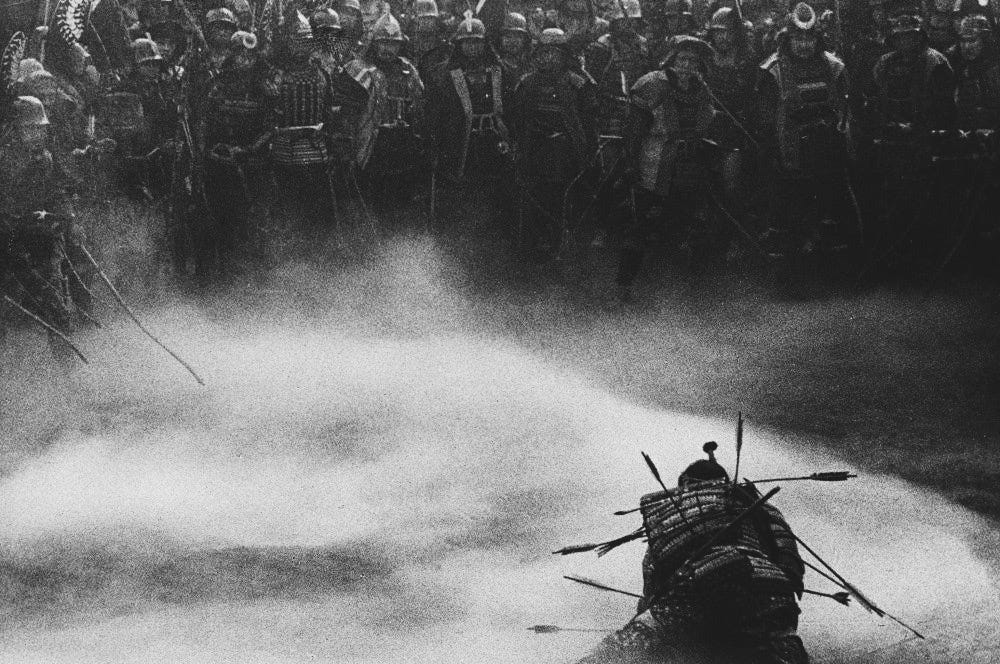
Pretend someone were to sculpt a Mount Rushmore of warriors.
Miyamoto Musashi would be on it. Musashi might even take the number one spot, replacing George Washington's brooding mug.
Musashi fought his first duel at 13. He fought 59 more over the course of his lifetime. He never lost. Not once.
He pioneered a sword-fighting technique poetically called Two Heavens as One. Most samurai carried two swords: a katana, and a shorter blade for close-quarters combat called a wakizashi. Musashi was the first samurai to fight with both—at the same time.
His most famous duel is worthy of a motion picture.
It took place against a samurai named Sasaki Kojirō on Ganryū Island. Kojirō was no chump. He was graceful. He was disciplined. He was technically sound. Kojirō's sword was legendary. It was nicknamed The Laundry-Drying Pole for its unusual length. His signature move, the Turning Swallow Cut, was said to be so swift it mimicked the flight of a swallow.
This fateful duel was scheduled for the morning.
But, Musashi didn't show.
Instead, he kept Kojirō waiting. And waiting. Finally, Musashi's boat could be seen bobbing on the horizon. Legend has it that Musashi had carved a wooden sword from one of the spare oars on the boat ride over.
It was slightly longer than Kojirō's enormous blade.
Kojirō was irate.
As Musashi stepped ashore, he said with a smile...
"You have already lost."
Kojirō lunged. Musashi sidestepped, bringing the wooden sword down on his opponent’s skull. He collapsed, dying shortly after.
Near the end of his life, Musashi traded out his swords for pen and paper. He became a philosopher, a strategist and a writer.
Just before his death, he shared 21 rules he lived by. I’ve recited them down below, adding some of my own thoughts where I felt it would be helpful.
1. Accept everything just the way it is.
Live without bias. See everything as it is, not as you wish it to be. For no amount of wishful thinking will change the truth. You know the truth. Deep down, you know the truth. Yet, you choose to ignore it. This ignorance might delay your suffering. But, it will not prevent it. Instead, accept everything just the way it is.
2. Do not seek pleasure for its own sake.
Pleasure and pain are two sides of the same coin. Do not live a life devoid of pleasure. However, do not seek pleasure for its own sake. For pain trails pleasure like a hungry hound. Remorse follows reckless spending. Headache follows careless drinking. Anxiety follows senseless fucking. You are not a monk. You need not behave like one. But, live like the tiger. The tiger feasts only after it hunts.
3. Think lightly of yourself and deeply of the world.
Take your work seriously. Yourself, less so. Ego is to judgment what fog is to vision. Live, work and love with confidence. But, understand the line between confidence and hubris is as fine as a strand of silk. Finer, even. Psychotherapist Esther Perel defines confidence as…
“The ability to see yourself as an imperfect, flawed individual while still holding yourself in high regard.”
Hubris is being blind to your imperfections, ignorant of your flaws. Confidence is seeing them fully, completely.
4. Never be jealous.
Jealousy shrinks your mind. It narrows your thinking. You obsess over what you do not have, rather than cherish what you do. When you believe in scarcity, you experience scarcity. When you believe in abundance, you experience abundance. Furthermore, fight jealousy with rationality. To be envious of something someone else possesses, you must be envious of what they paid to possess it. For no possession comes without tremendous cost. You are jealous of the house. But, are you jealous of the long nights and weekends that achieved the house but caused the divorce?
5. Be detached from desire your whole life long.
Desire is felt on the tongue and in the groin. Calling is felt in the heart. When someone or something commands your attention, notice where the feeling resides. Learn to delineate between obsession and ambition, lust and love—desire and calling. If you choose to act on the basis of obsession, lust and desire do not shame yourself. But, at the same time, respect yourself enough not to play the fool. Remember you are the easiest person to fool. If you pursue desire, do so with the awareness that it will never leave you full.
6. Do not regret what you have done.
There are no such things as mistakes. Only lessons. The lessons are repeated until they are learned. You either learn now or you learn later. But, you cannot learn and regret at the same time. Regret will only prolong the learning, as drought prolongs the cultivation of a crop. This does not free you from responsibility nor accountability. When you hurt someone, apologize. However, see to it that you forgive yourself in time (whether or not they are in a place to forgive you).
7. Never let yourself be saddened by a separation.
Those who are meant to stay, will stay. Those who are meant to leave, will leave. Those who are meant to return, will return. Do not beg anyone to stay. Do not push anyone to leave. Do not coax anyone to return. Instead, remain still. Remain solid. Remain honest. Remain forthright. All the while, allowing others to do as they please.
8. Do not, under any circumstances, depend on a partial feeling.
Acting on the basis of a partial feeling is gambling. If you choose to gamble, do not be surprised if you lose. For the odds are in the house’s favor. Investing is not the same as gambling. You will never have complete certainty in anything. In fact, courage is acting in the absence of certainty. But, there is such a thing as idiocy, stupidity and outright lunacy. If you choose to be a lunatic, at least smile as you carry your handbasket to hell.
9. Resentment and complaint are appropriate neither for oneself nor others.
Resentment is a sword that cuts both ways. It causes pain to the recipient of the blade and the individual wielding it. You do not have to forgive every trespass made against you. But, you must accept it. In fact, you must accept the trespass swiftly. For in the absence of acceptance, resentment blooms. You cannot accept and resent at the same time. Furthermore, do not complain. If you must complain, present a solution along with the complaint. Spend 10% of the time on the complaint, 90% of the time on seeing to it the complaint is solved.
10. Do not let yourself be guided by the feeling of lust or love.
While I’m in agreement with Musashi that lust is a fickle guide, love is the greatest, purest guide you can ever know. If you believe that to feel love is to know God, to ignore love is to turn your face away from your creator. Be wary of following lust—although there are many lessons lust can teach—but follow love with complete devotion.
11. In all things have no preferences.
Expect nothing. For even if your expectations are met, you will find yourself happy for only a short while. Soon, any joy that you feel will be replaced with more expectations. They are like lily pads in this way, expectations. Beautiful. Yet, capricious. They’re unable to support the weight of anything substantial. Instead, expect nothing. Live in a constant state of wonder. No—wonder isn’t the word. Surprise. Live in a constant state of surprise. Live moment to moment, unsure of what strange fruit the next moment might bear. Sometimes, you will bite into the fruit and become sick. Other times, you will bite into the fruit and feel the sweetness drip down your chin. Regardless, devour the fruit with no preconceived notion.
12. Be indifferent to where you live.
If you aren’t happy where you are, you will not be happy where you go. Ben Cake, a writer I very much admire, once said…
“I can be content anywhere, as long as I have a cup of coffee to drink and a book to read.”
Travel can expand the mind. But, at the same time, it can become a form of escapism. Be where you are. For wherever you go, there you are.
13. Do not pursue the taste of good food.
Bourdain would disagree wholeheartedly. Perhaps there is a middle ground? There is as much to be enjoyed in times of feast, as there is to be learned in times of fast. Do not feast at every meal. It thickens your waistline and loosens your resolve. However, if you must eat to stay alive, you might decide there is nothing wrong with the food you consume being both nutritious and pleasant on the palate.
14. Do not hold on to possessions you no longer need.
May your hands be a constant reminder that there is a limit to what you can carry. If you are like many, you might mistake possessions for wealth. But, possessions can become a form of imprisonment. Acquisition should come with sacrifice. If you bring something new into your home, something old must go.
15. Do not act following customary beliefs.
If you take a customary action, you will get a customary result. Belief is the genesis of action. Be wary of what you choose to believe. Perhaps it’s advantageous to believe that fortune favors the bold. So, be bold. Be courageous. Be tenacious. It was Napoleon Bonaparte who said…
“Audacity. Audacity. Always audacity.”
When in doubt, be audacious.
16. Do not collect weapons or practice with weapons beyond what is useful.
This is a bit hypocritical coming from a samurai who wielded not one sword but two. However, it is doubtful Musashi enjoyed the same prowess with the bow and arrow as he did the katana and wakizashi. It is not wrong to crave competence in a number of skills, but mastery is achieved through expertise in a single skill. Bruce Lee once said…
“I fear not the man who has practiced 10,000 kicks once, but I fear the man who has practiced one kick 10,000 times.”
Choose a weapon—maybe two—and swing it until the blade is dull.
Sharpen it, then swing it some more.
17. Do not fear death.
Fear sloth. Fear greed. Fear hatred. Fear never reaching your full potential. But, do not fear death. 117 billion people have been born on Earth. Not a single one has managed to escape death. It’s inevitable. It’s beautiful. And, if you believe in a higher power, it’s only the beginning.
18. Do not seek to possess either goods or fiefs for your old age.
Hoarding wealth for the future costs you enjoyment for the present. It is cliché to say, but tomorrow is not promised. So, devour the present. Devour the moment. Devour the hour. Devour the day. Understand that wealth is not strictly financial. It is spiritual. It is mental. It is emotional. If you are an artist, do not sit on your hands and wait for another day to make your masterpiece. Delay is lethal to the artist. In the words of Annie Dillard…
“Spend it all, shoot it, play it, lose it, all, right away, every time. Do not hoard what seems good for a later place in the book or for another book; give it, give it all, give it now. The impulse to save something good for a better place later is the signal to spend it now. Something more will arise for later, something better. These things fill from behind, from beneath, like well water. Similarly, the impulse to keep to yourself what you have learned is not only shameful, it is destructive. Anything you do not give freely and abundantly becomes lost to you. You open your safe and find ashes.”
Spend it all.
19. Respect Buddha and the gods without counting on their help.
Believe in God. Respect him. Love him. Thank him. Cherish him. But, do not count on him to save you. He gave you lungs so you can breathe. He gave you legs so you can run. He gave you hands so you can create. He gave you fortitude so you can save yourself. I’ve read of many acts of divine intervention in holy texts. But, I have yet to witness one with my own eyes. This is not proof that God does not exist—be him Buddha, Allah or whatever it is you choose to call him—but he is a silent partner. His silence requires the presence of faith.
20. You may abandon your own body but you must preserve your honor.
Samurai committed Seppuku. To the modern Western mind, this ritual form of suicide is impossible to wrap one’s head around. Samurai committed Seppuku for a number of reasons. To avoid capture, torture or execution. To accept responsibility for failure. To protest a lord’s decision. To demonstrate moral conviction. To follow a deceased lord into death. Yet, regardless of the intention, the act revolved around one central idea. To preserve their honor. For maintaining one’s honor was considered more valuable than continued life.
21. Never stray from The Way.
The Way is different for each of us. For Musashi, it was these 21 principles. For you, it might be Jung, Jesus, Kant, Woolf or Plath. Once you’ve found The Way, remain faithful to The Way—especially in moments when your faith is tested. As an adman myself, I would be remiss if I did not mention an adman at least once in this essay. Bill Bernbach once said…
“A principle is not a principle until it costs you money.”
This is how you know you’ve arrived at The Way. You’ve stood by your beliefs, rules and principles when it has cost you, when it has inconvenienced you, when it has left your heart broken but your soul intact.