

I woke up Saturday morning mildly hungover, looking for answers.
The day was hot and humid.
It was as if a tremendous fire raged beneath the city and officials had kicked over an enormous vat of water in hopes of cooling the asphalt underfoot.
I had just picked up a collection of David Lynch’s visual work titled Someone Is in My House. It was sealed in a piece of translucent plastic to keep tire-kickers from creasing the pages. I declined the clerk’s offer of a tote and instead tucked the book under my arm. As sweat colored my shirt from gray to black on the walk back to my flat, I was thankful for the added layer of protection.
Two, maybe three blocks from my building, I nearly tripped over an A-frame sign on the sidewalk advertising palm readings by a woman named Madam Faye.
I’m a believer in Carl Jung’s theory of synchronicity—the idea that you should pay attention to the things you pay attention to, as they function like little signal fires from your subconscious.
I decided to go in.
There was a stenciled hand on the sign pointing to an entrance on my right.
As I entered, I thought back to a field trip I took to Mammoth Cave as a child. The guide leading me and my classmates into the belly of the cave wanted to show us what true darkness looked like—and so he asked us to hold hands and stand still before killing the lights
It was terrifying.
The stairs were covered in a hideous, moth-eaten shag carpet that I would have felt tempted to remove in a past life. Once I had reached the top, I found myself face to face with a man quietly enjoying a cigarette. He looked less like a palm reader and more like someone you’d score an eight-ball off of.
He took a long drag from his cigarette, stubbed it out and added it to the bent-over bodies in the ashtray. “Don’t worry,” he said. “I’m not the palm reader. I’m just the quarterback.” He stood up and knocked on the heavy metal door beside him.
Soon, Madam Faye appeared.
While Madam Faye looked more like a palm reader than the man whom I assumed to be her boyfriend, her appearance didn’t instill an overwhelming sense of confidence.
Wearing a bright blue jumper, a red lip, a pair of cream-colored VEJA sneakers and a Michael Kors handbag, she was far from bohemian.
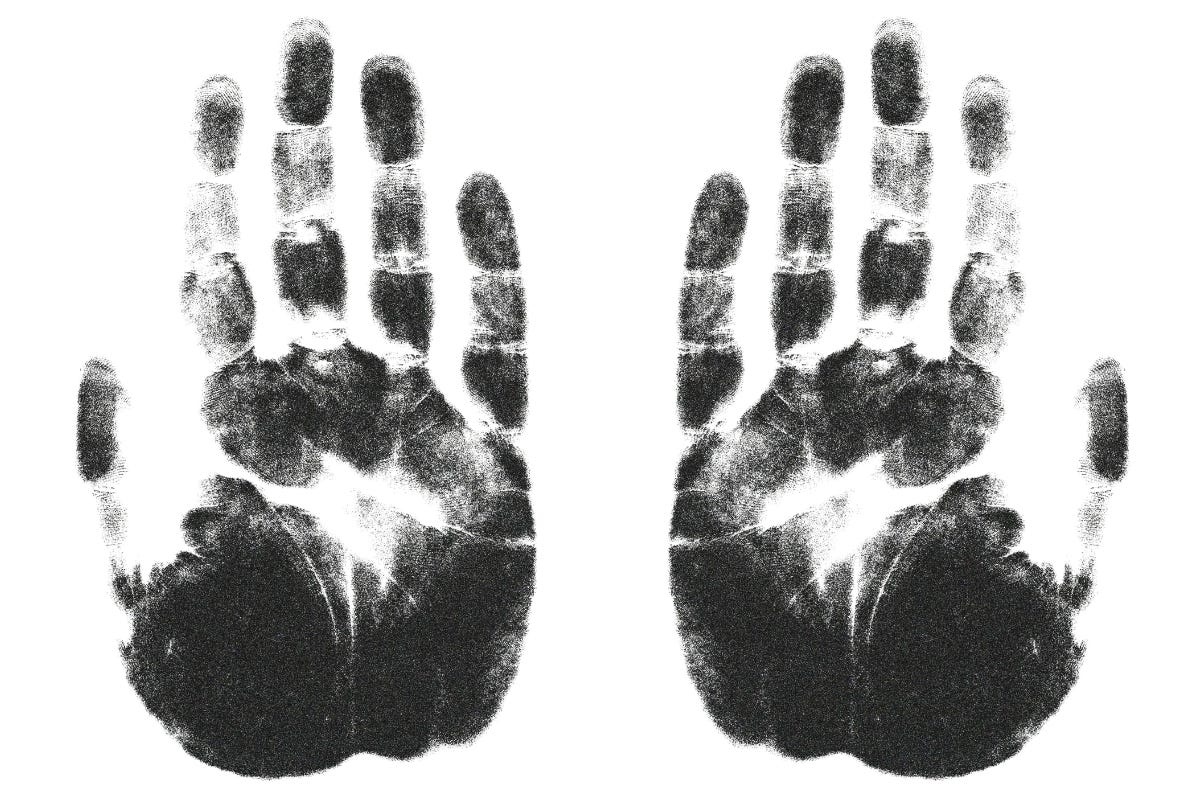
She told me to take a seat and turn over my palms. I obeyed. Madam Faye gazed at them—for what felt like an extraordinarily long time—with furrowed brows.
For a moment, I wondered if she had fallen asleep.
When she finally spoke, she recited a line that so many palm readers say to their customers: “In your last relationship, you felt like you gave more than you received.”
This is called a Barnum statement.
It’s named after the showman and politician P.T. Barnum.
While running the P.T. Barnum's Grand Traveling Museum, Menagerie, Caravan & Hippodrome, the showman boasted of a program that “offered something for everyone.”
P.T. Barnum recognized that universality is achieved through specificity.
He would often make statements—before teeing up his shows—that felt specific to the individual but, in actuality, were universal to everyone in the audience.
Statements like “Your generosity is often taken for granted” or “You believe you’re capable of more than you’re achieving now” made the hundreds of thousands of people who attended his countless shows feel as though P.T. Barnum was speaking directly to them.
Believe it or not, they aren’t bullshit.
Well, they are bullshit. But, they work.
Back in 1948, a psychologist by the name of Bertram Forer ran an experiment. He gave his students a personality test. Afterward, each student received what they believed was a personality assessment specific to them.
They rated its accuracy astonishingly high—roughly 4.3 out of 5.
But, what these students didn’t know, was that they each received exactly the same assessment as their peers, regardless of the answers they provided on the test.
The assessment contained Barnum statements like “You have considerable unused capacity” and “At times you have serious doubts about whether you made the right decision.”
I don’t need to impress upon you just how universal these statements are.
Everybody feels like they are capable of doing and achieving more, just like everybody finds themselves doubting the decisions they’ve made. But, we make these statements specific because we attach our own experiences to them.
This is what keeps palm readers in business.
Palm readers recognize the vast majority of people who visit them are doing so because they’re experiencing some degree of romantic turmoil.
More often than not, a relationship has ended—or is fraying at the ends—and the individual sitting across from them is searching for an answer.
A Barnum statement like “In your last relationship, you felt like you gave more than you received” has a high likelihood of resonating. More importantly, it feels specific to the individual, despite being universal to just about everyone.
Deep down, each of us knows that if someone possessed the psychic ability to actually read our palms and determine our future, they wouldn’t be charging just $15 per palm (or $25 for two).
But, people don’t visit palm readers for rational reasons. They visit palm readers because they are desperate for certainty—even if it’s a false sense of certainty—even if it requires them to travel up the staircase of some dark, dingy apartment building at the risk of being mugged or murdered or both.
I don’t look down upon palm readers. If they didn’t provide some degree of value for the human race, they wouldn’t be hawking their services on every street corner in Manhattan—the market simply wouldn’t support them.
We tell ourselves stories in order to live.
People pay palm readers not because palm readers can predict the future, but because they provide stories that offer a sense of certainty.
We live in a world that is incredibly strange, confusing and scary. To get by, we do precisely what Joan Didion once wrote…
“We tell ourselves stories in order to live.”
Palm readers give us stories we can live with—as do self-help authors, cults, life coaches, tarot card readers, astrology applications like Co-Star and the many self-assured writers (like myself) you will find on platforms like Twitter, Instagram, LinkedIn and Substack.
At the end of Madam Faye’s reading, she attempted to upsell me.
She said, “I’m sensing a blockage with you. I don’t know what it is. But, it’s standing in the way of everything you want in life, love and work. For $325, I can clear this blockage.”
I politely declined, wiped the sweat from my brow, handed her $25, picked up my book and left. Madam Faye didn’t realize it, but she had given me what I came for.
This essay.
Love it. Money well spent.