Write when disaster strikes.
How a writer's overwhelming grief led to the creation of Frankenstein.
Two centuries ago, Mount Tambora in Indonesia erupted. This ignited a chain reaction that sent ripples across every corner of the globe. It was chaos.
Debris spilled into the stratosphere, creating a vast aerosol shield. It blotted out sunlight and lowered global temperatures by roughly one degree Fahrenheit.
Goodbye, summer.
What followed was the The Year Without Summer.
Crops dropped like flies across Europe and North America. Grain and oat prices swelled. Rains drowned entire farmlands in Ireland. Cholera killed millions in India. Hundreds of thousands of people died of starvation.
Meanwhile, during this dark and depressing year, a novelist by the name of Mary Shelley holed up in a villa outside of Geneva, Switzerland. She wasn’t alone. Her beloved Percy and her son William accompanied her, as did her friends.
Shelley and her party stayed inside, weathering the year without summer by discussing philosophy, literature and art.
Story time.
Nearby was the English poet Lord Byron. Shelley and company would often visit him in the Villa Diodati. To pass the time, Lord Byron would challenge his guests to write—and later recite—their scariest ghost story.
It was after one of these retellings that Shelley suffered a nightmare that spawned one of the greatest novels of the 19th century.
In an author’s introduction to what would later become her first novel, Shelley wrote…
“I busied myself to think of a story… One which would speak to the mysterious fears of our nature and awaken thrilling horror—one to make the reader dread to look round, to curdle the blood, and quicken the beatings of the heart. If I did not accomplish these things, my ghost story would be unworthy of its name.”
She woke from the dream and wrote it down.
Frankenstein was born.
When Shelley shared her story the following night, the other guests at the villa were horrified. This encouraged the twenty-year-old Shelley to write and publish her very first novel, Frankenstein.
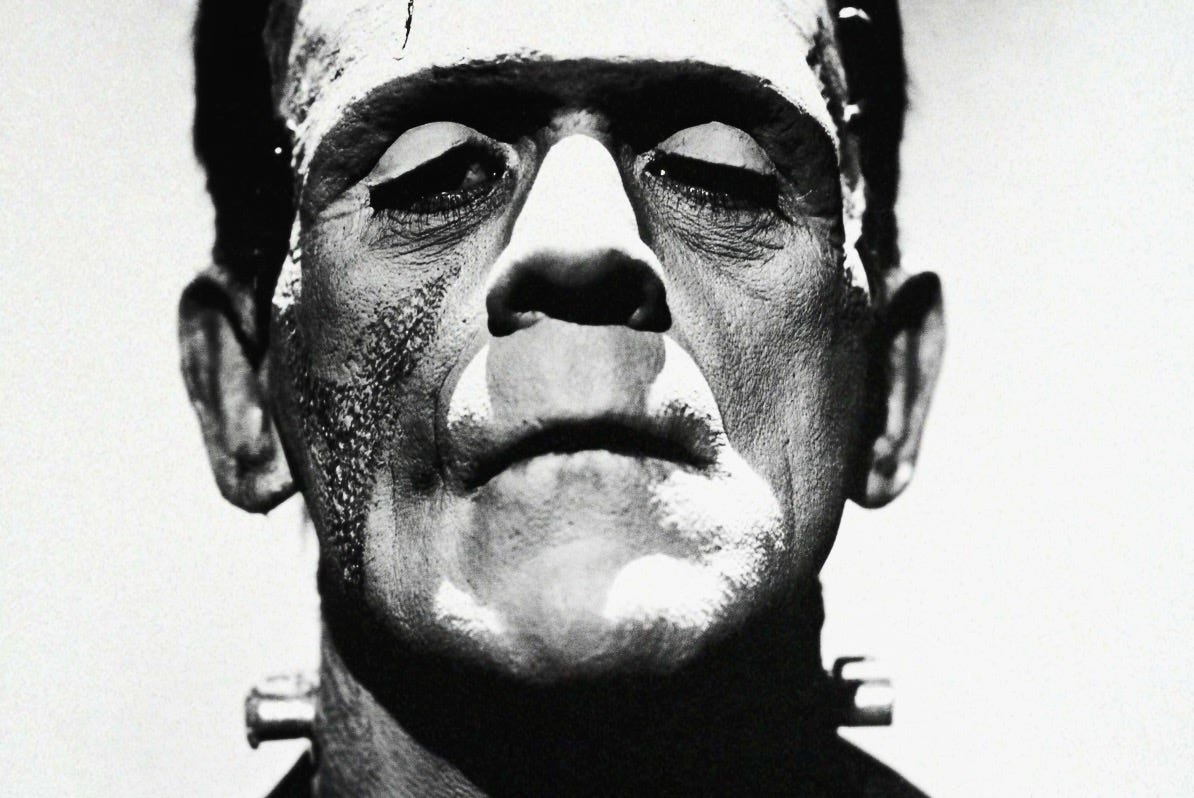
A story about a mad scientist who created a monster by sewing together severed body parts and breathing life into the being with enormous amounts of electricity.
In Hilde Østby’s wonderful book on creativity, The Key to Creativity, she theorizes that Frankenstein was Shelley’s way of mourning the death of her daughter, whom she had lost the previous year.
While Shelley would go on to become one of the most important writers of the 1800s, her life was haunted by tragedy.
Of the four children she would have with her beloved Percy, only one would survive—and Percy himself would later die tragically at just thirty years old.
It’s rumored that after his death, Shelley kept Percy’s calcified heart on her writing desk (which is wildly romantic in an eerie sort of way).
Shelley, today, is considered the godmother of science fiction. Her legacy exists as a testament that while we can’t control the tragedies that befall us, we can control the art that rises from their ashes.
By Cole Schafer.


