

I’ve always prided myself in being fairly disciplined. However, lately I’ve been a bit frustrated—if not mildly disgusted—by my lack of discipline. I’m still writing. I’m still creating. I’m still producing. But, it’s much harder than it used to be.
Some of this difficulty is excusable. I no longer have the immense, uninterrupted gaps in my schedule that I once enjoyed. Running Honey keeps me caroming between client meetings, internal creative reviews, Slack channels and email threads.
Spending days, if not weeks, fully immersed in the creative process is a relic of the past. It’s simply no longer my reality.
With that said, limited time isn’t a scapegoat.
Toni Morrison was a prolific writer.
Over the course of her storied career, she wrote eleven novels—along with numerous memoirs, essays, plays and children’s books. She managed much of this while working a full-time job as an editor and raising two children as a single mother.
Back in 1993, Morrison sat down with The Paris Review to discuss her creative process. She explained how—in the early days of becoming a writer—she would write before dawn while her children were asleep.
Eventually, this necessity became a habit. She continued to do the bulk of her writing in the wee hours of the morning, even after her kids had grown up and moved out.
In her own words…
"I’m very, very smart in the morning, and everything is clear. By noon it’s over."
I’m busy. But, I can assure you, I’m not as busy as a single mom.
This begs the question: Is time really the issue? Or, am I simply becoming less disciplined in the time that I have?
My hunch is the latter.
Hence why I’m writing this essay.
In an effort to wrestle back my discipline, I decided to sit down and write this essay.
I loathe self-help. I try not to read it, if I can help myself. Pun very much intended. I try not to write it, either. However, desperate times call for desperate measures.
And, so here I am, writing self-help.
When I first began this essay, I didn’t expect it to become one of the longer, more extensive essays I’ve written (at least here on Substack). Nor did I anticipate it taking the shape that it did.
If you decide to read this from start to finish, you will notice the writer—yes, I’m speaking in the third person—contradicts himself on more than one occasion. There were previous versions where I bleached out these contradictions.
After sleeping on it, I felt the contradictions were what made it human. Writing this short introduction in retrospect, I realize the piece has far less to do with reaching for greater discipline and far more to do with holding onto the gorgeous qualities that make us human.
A sign of the times.
You and I live in an era that is becoming increasingly more comfortable, convenient and instantaneous. We are surrounded by more luxury than the monarchs of Versailles. At times, it feels as though we have the entire world on a string.
Companies like OpenAI and Anthropic are developing technology that is only making this string shorter by the day. Before long, we will have the ability to run our entire lives from a single text thread.
I was catching up with a close friend of mine a couple weeks ago. He was telling me about OpenAI’s Dot. It sounded like something straight out of a Ray Bradbury novel. He shared a story about how he purchased an expensive bag for his girlfriend. The very next morning, he woke to find a message from Dot that read…
“The bag you purchased yesterday just went on sale. Would you like me to email the company? I think I can get some of your money back.”
Like any smart, money-minded individual, my friend gave Dot the green light. Dot emailed the company on his behalf, negotiated with customer support and won back $70 of his hard-earned cash.
An hour later, my friend received a follow-up message from Dot…
“Victory.”
I’m not anti-AI. Nor am I under the assumption that AI is going anywhere. Wishing away AI is like wishing away the automobile in the days of horse-drawn carriages.
For better or worse, it’s here to stay.
Furthermore, I see this specific example as a very good use case for AI. If Dot can help folks like my friend save seventy dollars without lifting a finger, that’s technology I can get behind.
Yet, I’d be ignorant to believe the convenience AI provides comes without a real cost—even if that cost isn’t monetary. What happens when we expect everything in our lives to function in the same manner as my friend’s $70 reimbursement?
What happens to our discipline when friction becomes non-existent? When inconvenience becomes scarce? When patience becomes unnecessary? When the smallest degree of discomfort becomes an anomaly rather than a normal everyday occurrence?
I can’t pretend to know what these frictionless times are doing to humanity’s discipline. But, I’ve slowly become more aware of what it’s doing to mine.
Ankle braces and exoskeletons.
Back in 1998, Kurt Vonnegut and Lee Stringer sat down in a New York City bookstore and had a conversation about the creative process. If you weren’t one of the several hundred people in attendance, the discourse was captured in Like Shaking Hands with God. You can eavesdrop there.
Toward the end of the discussion, Vonnegut asked Stringer about his education. Stringer answered…
“Just high school, but it was a good one.”
Vonnegut was highly educated. He studied biochemistry at Cornell, journalism at Butler and anthropology at the University of Chicago. And so I found it surprising—if not reassuring—when Vonnegut responded in kind…
“That’s the story of my life too. I went to a good high school, and everything was noise after that.”
While I’m not nearly as educated as Vonnegut, I share this same sentiment.
During a basketball practice in high school, I twisted my ankle. It was painful. It was jarring. It was grotesque. I was surprised to find that my foot was still attached to my leg when I looked down.
It swelled to the size of a grapefruit and took on the color of a rotten orange. After two weeks of dunking the throbbing mass in a 5-gallon bucket filled with ice, I began the excruciating process of rehabbing it.
Once I could finally walk on it again—without folding like a scarecrow in a cyclone—I did so with the help of an ankle brace. I recall walking past my athletic trainer one afternoon before practice.
He stopped me and said…
“If you don’t take that thing off soon, you will have to play with it for the rest of your life.”
He was a hard-nosed, old-school type of trainer. He explained to me that a brace functioned like an exoskeleton. If my body got used to wearing it, my muscles, tendons and ligaments would eventually atrophy. I doubt the science behind this stands. But, I always liked the sentiment.
I’m in the midst of reading an enormous sci-fi epic called Hyperion.
There is a race of humans called the Ousters who’ve lived and bred for generations in zero gravity. When they touch down on planets where gravity is present, they do so in exoskeleton-like suits that allow their atrophied bodies to support their own weight.
I can’t think of a better metaphor for my relationship with the modern conveniences spawned by the constant advancements in AI. An ankle brace is a splendid piece of technology to wear when injured. However, you must be careful not to become so accustomed to wearing it that you fear walking without it.
I’m not a psychologist. I’m a working writer, artist and adman who has witnessed my own discipline erode like a sandcastle at high tide. That said, please take everything you’re about to read with a grain of salt.
Or, sand rather.
Writing strictly from my own experience, I have a hunch the only way I can earn back my tenacity, resilience, discipline—whatever you might choose to call it—is by removing the ankle brace.
And, in doing so, reintroduce a degree of struggle in my own life.
To clean up the mess, you must pick up the trash.
If you’re anything like me, you might think that discipline is about doing extraordinarily difficult things.
Climbing Mount Everest. Running a marathon. Deadlifting 500 pounds. Fasting for days on end. Building a trillion-dollar company in some California garage. Fighting your way back from a 20-point deficit in the 4th quarter of the NBA Finals.
These are all acts of discipline, sure.
However, they give the false impression that discipline is a trait reserved strictly for extraordinary people. Because most of us wouldn’t consider ourselves extraordinary—myself included—discipline can feel entirely out of reach.
Psychologists think otherwise.
Back in 1977, a psychologist by the name of Albert Bandura developed the theory of self-efficacy. At its simplest, self-efficacy is our belief in our ability to take actions that influence the outcomes in our lives.
One of his central insights was that successfully doing difficult things—no matter how small—develops confidence in our ability to do increasingly difficult things in the future. Bandura called these tiny, seemingly insignificant successes mastery experiences.
If you ever watch Shohei Ohtani play baseball, you will notice a peculiar habit.
He picks up the trash from the baseball field. Not just his own trash. Everybody’s trash. It’s not a publicity stunt. It’s been widely documented for years.
Ohtani might be the greatest player to ever pick up a baseball. Yet, he finds time—in just about every game—to pick up a piece of trash on the field.
Some believe this is his way of creating good karma for himself.
Viewed through Bandura’s theory, Ohtani picking up the trash presents an opportunity to do something a little uncomfortable, a little inconvenient and—let’s face it—a little unnecessary.
Does this habit make him a great baseball player?
Absolutely not.
If this were the case, anyone who plucked the discarded tin cans littering the streets of their neighborhood would find themselves in the major leagues.
But, I do believe that each time Ohtani picks up a piece of trash on the baseball field, it serves as a small reminder to himself that he is capable of doing increasingly difficult things in the future.
I'm not suggesting we should go out of our way to make our lives miserable. We shouldn’t walk around with tacks in our shoes or Icy Hot on our crotches just because it’s wickedly unpleasant.
There's nothing admirable about suffering simply for the sake of suffering. Still, I do feel strongly that the small, inconvenient things we choose to do (or not to do) have a significant influence over our discipline and our character.
A spiritual argument for cleaning your toilets.
When I find myself out of sorts, I visit a tea master in Louisville, Kentucky.
His name is Rohit. He was previously a software engineer at an enormous healthcare conglomerate. One morning, he woke up and realized he was miserable. So, Rohit quit his job and went back to school to become a math teacher. In his downtime, he transformed his home into a Japanese tea house.
Today, when he isn’t teaching high school calculus, he hosts elaborate tea ceremonies. While Rohit would never describe himself as a guru, I always leave his teahouse feeling both grounded and more at peace than I first arrived.
Last time I visited him, Rohit told me he was cleaning his toilet every morning. Naturally, I asked him why. He shrugged and said something to the tune of…
“When I start out my day cleaning my toilet, everything after that becomes easier.”
Japanese business founders and executives share a similar practice. Soichiro Honda was notorious for cleaning Honda’s toilets.
I’m being a bit cheeky—another pun very much intended—but I wonder if some of America’s more disagreeable founders would behave less like assholes if they got down on their hands and knees every once in a while and cleaned a commode.
While I can’t say I clean my toilet every morning, I’ve begun the practice of tidying up the space around me.
I’m making my bed as soon as I wake up. I’m washing down the countertops after preparing a meal. I’m picking up the fallen leaves dropped by the many plants that inhabit my home. I’m fluffing my pillows, putting away my shoes—rather than leaving them at the door—and folding every one of my bath towels into aesthetically pleasing oversized Swiss rolls.
Today, I saw a large electric-blue Cool ranch Doritos bag that someone discarded on the street outside my house. I picked it up—along with a half-empty Coke can and a busted to-go box that appeared to once contain Chinese food—and tossed it in the waste bin. Previously, I’m ashamed to admit, I would have let the wind carry it down the street to someone else’s house.
Every time I go out of my way to do something small that I don't necessarily want to do—like picking up someone else's litter from the street—I find it easier to do the things I want to do but find difficult, like writing this essay, practicing patience with a loved one, losing myself in a book or fully immersing myself in a conversation with a close friend.
A beautiful day in the neighborhood.
Fred Rogers is a strange individual to reference in an essay about discipline.
Please, hear me out.
In a world obsessed with being great, Mr. Rogers showed humanity it was perfectly satisfactory to be good. He didn’t just do this through his words. He did it through his actions—which speak volumes on the topic of character, if not discipline.
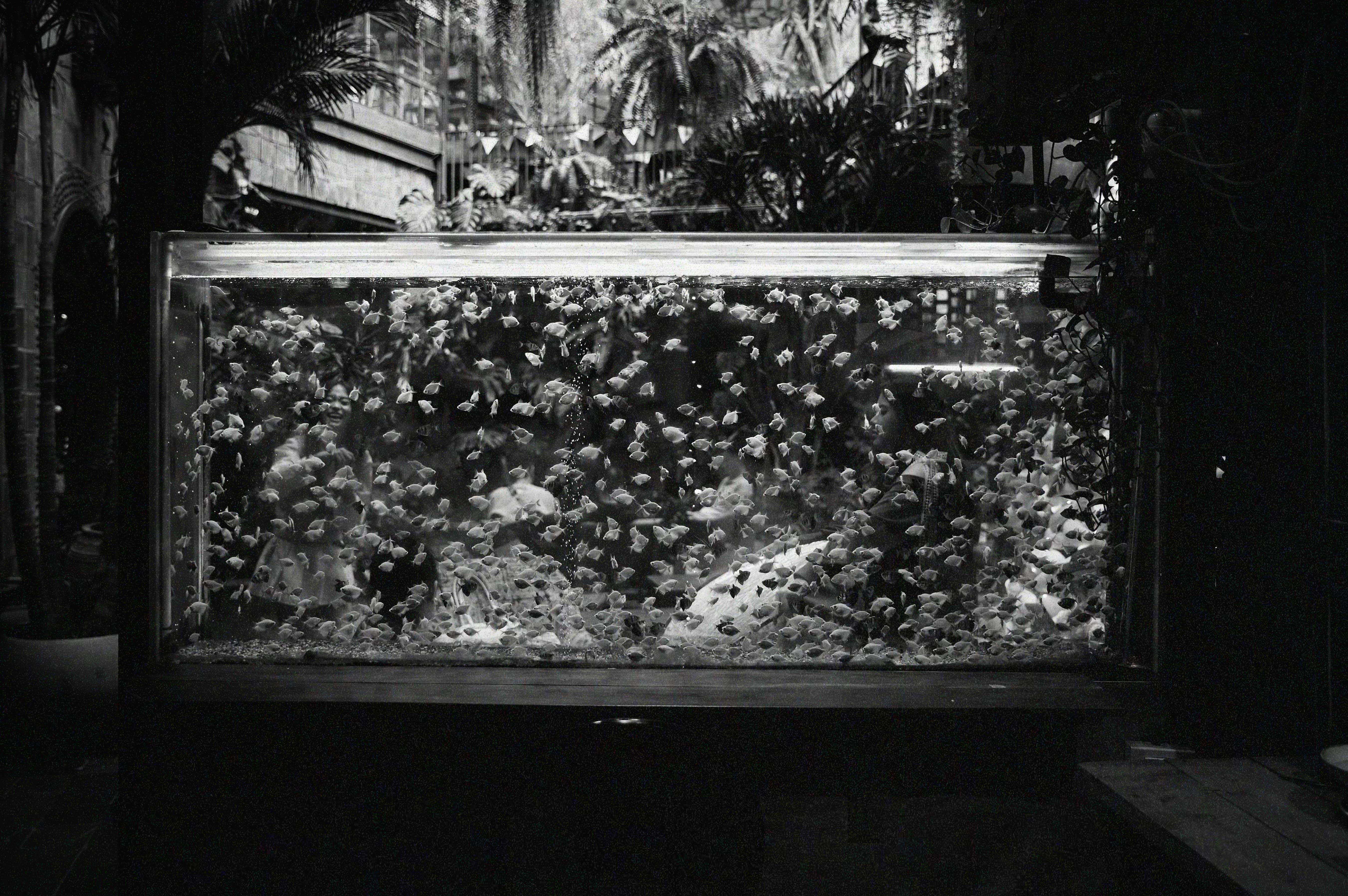
If you’ve ever seen Mr. Rogers’ Neighborhood, you will notice there is a moment in every episode where he feeds the fish.
One day, a five-year-old girl who was blind wrote Mr. Rogers.
She was concerned about the fish. Because she could not see him feeding them, she was worried they were going hungry.
From that moment on, Mr. Rogers didn’t just feed the fish, he announced to her—and the other millions of children tuning in—that he was feeding the fish.
At first glance, this doesn't appear to be a story of discipline. Perhaps it's not. Perhaps it's a story about character. Perhaps discipline and character are two sides of the same coin.
Mr. Rogers didn't have to announce that he was feeding the fish, did he? And yet—he chose to do so anyway. That’s the beauty in the gesture.
Nobody would have known if he'd forgotten about the little girl and her letter. But, he remembered. Day after day, he remembered. Year after year, he remembered. He continued doing something small—and a bit inconvenient—because he believed it mattered.
Discipline isn’t about doing extraordinary things. It’s about becoming the kind of person who can be counted on to do the ordinary things that so many people overlook.
Not to mention, regularly doing ordinary things gives us the discipline to do something extraordinary.
A beautiful day in the senate.
Back in 1969, the Nixon administration had plans to cut millions of dollars in public television funding. The costs were real. PBS would be gutted. Sesame Street would be closed. Mr. Rogers’ Neighborhood would be shuttered.
Unless, someone could convince a stubborn, short-tempered senator by the name of John Pastore otherwise. Moments before Senator Pastore was about to drop the guillotine, Fred Rogers walked into the hearing room and took a seat.
Speaking in the same soft tone he used on his show, Mr. Rogers told the story of why children need television.
He explained how shows like Mr. Rogers’ Neighborhood helped kids name scary emotions like anger, fear, jealousy and loneliness. When he had Senator Pastore’s undivided attention, he unveiled a single piece of paper and recited the lyrics to one of his songs...
What do you do with the mad that you feel
When you feel so mad you could bite?
When the whole wide world seems oh, so wrong...
And nothing you do seems very right?
When he was finished, Senator Pastore looked at him with a glimmer in his eye and said…
“I think it’s wonderful. Looks like you just earned the twenty million dollars.”
Let’s close out this thing out, shall we?
We’re dancing animals.
As I fumble towards the end of this piece, I’m realizing in real time that I’ve lost the plot. Why did I feel the need to share Mr. Rogers’ extraordinary success in the senate to justify his very kind, ordinary gesture of easing the anxieties of a little girl?
I strongly considered ending this with some clever line like: Feed the fish every day, and one day you'll be able to take on a shark.
But, that’s not the fucking point.
Back in 2005, Vonnegut sat down for an interview with the journalist David Brancaccio to discuss his essay collection, A Man Without a Country.
During that interview, Vonnegut shared a story that I believe is more timely now than it was back then…
“Oh, she says, well, you’re not a poor man. You know, why don’t you go online and buy a hundred envelopes and put them in the closet? And so I pretend not to hear her. And go out to get an envelope because I’m going to have a hell of a good time in the process of buying one envelope.”
Vonnegut continues…
“I meet a lot of people. And see some great looking babies. And a fire engine goes by. And I give them the thumbs up. And I’ll ask a woman what kind of dog it is. And, and I don’t know. The moral of the story is—we’re here on Earth to fart around. And, of course the computers will do us out of that. And what the computer people don’t realize, or they don’t care, is we’re dancing animals. You know, we love to move around. And it’s like we’re not supposed to dance anymore.”
I began this essay in search of my own fleeting discipline. As I attempt to end it now, I’m afraid I’m left with more questions than answers.
What I do know, though, with some certainty, is that I’ve spent my entire goddamn life trying to be great. Any activity, gesture or practice that couldn’t directly help me in my pursuit of greatness has felt arbitrary.
At times, this thinking has left me a bit jaded. Take the Ohtani example I mentioned earlier. My gut reaction was to connect his habit of picking up the trash with his ability to do hard things. This very well may be the case.
But, what if Ohtani picks up the trash for another reason? What if Ohtani picks up the trash simply because he believes it’s the right thing to do?
You get to this age where your life looks very different from what your younger self imagined. Most of what you had hoped to achieve hasn’t happened and you can’t help but question whether the dogged chase all those years was worth it.
I used to believe that through discipline and sheer will I could achieve anything I set my mind to. It’s been both humbling and liberating to realize I have far less control than I originally thought.
This isn’t just true for me. It’s also true for you.
So, what do we have control over?
We can control how we show up. We can control seeing the trip to the post office as a treat—rather than a chore. We can control smiling at the baby in the stroller—rather than looking the other way. We can control waving at the fire truck. We can control picking up the trash on the sidewalk. We can control sitting down each day in an attempt to write—even if the words refuse to come out. We can control being entirely present in conversation with friends and loved ones. We can control singing in the shower. We can control dancing in the kitchen.
We can control feeding the fish.