

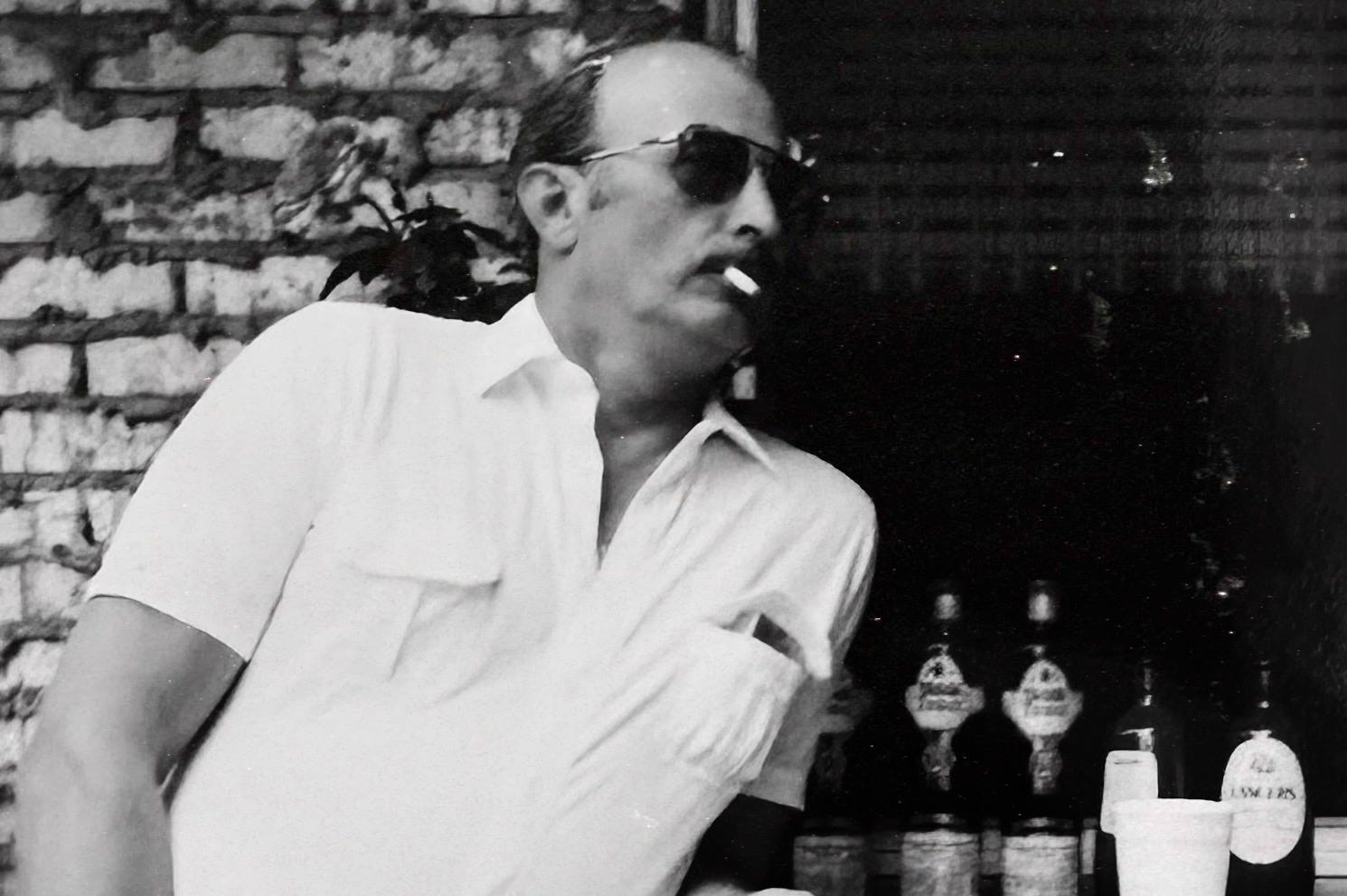
This is a photograph of my grandfather smoking a cigarette in Princeton, Indiana.
Papa never wore an Oura Ring.
He preferred the ruby ring my grandmother gifted him one year for his birthday. It took her months to scrape together the money from her factory job. At the end of his days, when he removed it from his finger to pass it on to my father, there was an indentation in his skin—not unlike the matted-down carpet that sits beneath a heavy piece of furniture that has remained unmoved for decades.
Papa smoked like a chimney.
He sipped at his Camels for nearly twenty years, finally quitting them for good when he fell head over heels for his five grandchildren. Nicotine gum became his next vice, the lesser of two evils. When I close my eyes and picture him now, I see an image of his jaw in constant motion, like a slow-moving locomotive.
Papa ate like a horse.
He cleaned his plate. He buttered his Oreos because he wanted more “filling.” That was until he discovered there was such a thing as Double Stuf. He loved taking me out for ice cream, where we would each order a hot fudge sundae. We’d eat in the car, in the dead of winter, with the heat running hotter than a lion’s mouth. As we’d whittle away at our desserts with our plastic spoons, he would recite the stories from his days in the Navy.
Papa loved a cold beer.
He salted his Millers before he downed them. This peculiar habit apparently “brought out the flavor.” I loved to watch him do it, leaning in close to the glass like a child admiring a fish tank in a dentist’s office. As the salt would tumble down through the lager, it would leave behind fizzy chemtrails. After his triple heart stent, my grandmother bought salt shakers with tiny holes in the lids. She would fill them with great big Himalayan rock salt. Anything, to keep his blood pressure from reaching meteoric levels.
Papa lived until he was eighty-two years old.
He never met a stranger. He looked everyone in the eye. He remembered your name. He would always lend a helping hand. He could tell a damn good story. At times, he was guilty of embellishing. He loved an honest day of work. If a job was worth doing, he always did it right. He adored my grandmother, even in the moments she made him madder than a hatter. He married her twice. Once in Japan. Once in America.
And, at the end, as Papa lay dying in his hospital bed, he took my hand and said, “I’ve lived such a full life. I wouldn’t change a thing. I’m ready.”
Is it just me, or have we lost the plot?
When we optimize our lives, we forget how to live.
We reach for our Oura Rings before our wedding bands. We lift weights three days a week, but are too busy to help our friends move. We attempt to double and triple our income, yet we grimace at the idea of tipping our baristas more than a dollar. We ruthlessly guard our eight hours of sleep, forgetting the moments we cherish most happened after 9 p.m. We sell our souls to build our followings, but never take the time to pick up the phone and call our friends.
We turn down a slice of our mother’s tiramisu because it doesn’t abide by whatever strange diet we’re following that season. We decline coffee with our father because we’re cutting back on caffeine. We refuse a bottle of wine with our beloved because we’re scared of a mild hangover.
And, I’m the worst of us. Honest to God, I’m the worst of us. I’m so concerned with being great—I forget how important it is to be good.
Papa is my constant reminder.
"I’m so concerned with being great—I forget how important it is to be good." (A good line from a good heart)
This one hit hard. Optimizing everything all the time comes at a cost. Glad we didn't lose the greats to this trait. My grandmother was a soft, strong, gentle fighter who lived to travel the world with friends and experience life deeply with those she cared about. I was blessed to know her and think of her often when I'm making a mountain out of a mole hill or obsessing with what "needs to be done." She was here long enough to give me a perspective and experience with presence I'll cherish forever. I'm working on being worthy to pass it along - by trusting it and living it - not optimizing it.